

It's Something You Become
Every week, we get the same question from beginner artists: "How do I find my style?"
You look at artists you admire. One draws with exaggerated manga proportions. Another paints hyper-realistic skin. Another uses bold geometric shapes. So you ask: How do I develop something uniquely mine?
And here's the uncomfortable truth: You're asking the wrong question. You don't "find" your style like it's a lost key. Your style doesn't exist yet — it's being built, piece by piece, choice by choice, every single time you create. I've taught this to 600,000+ artists at Artma, and the artists who stop searching and start building are the ones who actually develop authentic voice.
There's a pervasive belief in the art world: style is something you discover. Like it's already inside you, waiting to be unlocked.
This is beautiful. It's also incomplete.
Style is not something you find. It's something you earn through repetition, experimentation, and reflection. It's the byproduct of thousands of hours of practice, informed by the artists who've influenced you, shaped by your life experiences, and defined by the aesthetic choices you make again and again until they become automatic.
Think of a jazz musician. Miles Davis didn't wake up with a "cool jazz" style already embedded in his soul. He learned trumpet fundamentals. He studied the masters. He played in ensembles. He failed. He experimented. He made choices. Over decades, those choices accumulated into the unmistakable Miles Davis sound — but it wasn't waiting for him to "find" it. He had to build it.
Your art style develops the same way. Not through divine inspiration. Through deliberate practice and conscious choice.
Here's where most artists get stuck.
When you admire another artist, the instinct is to copy them. You study their lines. You mimic their shading. You trace their proportions. But copying someone's surface is a dead end — it creates work that looks like a poor imitation, not an original voice.
This is the difference between inspiration and imitation:
Imitation: Your favorite artist uses sharp, angular lines. So you make your lines sharp and angular, just like them. Result? You look like a discount version of them.
Inspiration: You notice your favorite artist uses sharp lines for emotional intensity. You understand the principle. Then you ask: What principle creates intensity in my work? Maybe it's color contrast. Maybe it's exaggerated gesture. Maybe it's negative space. You take the lesson, not the surface.
When you study artists, you're not collecting a wardrobe of techniques to wear. You're understanding the principles they've mastered so you can apply those principles in your own unique way. This is why learning the common mistakes beginners make helps so much — it accelerates your understanding of which principles actually work.
And that's exactly what makes it yours.
Every artist is a product of their influences. But here's what makes you unique: your specific combination of influences is unrepeatable.
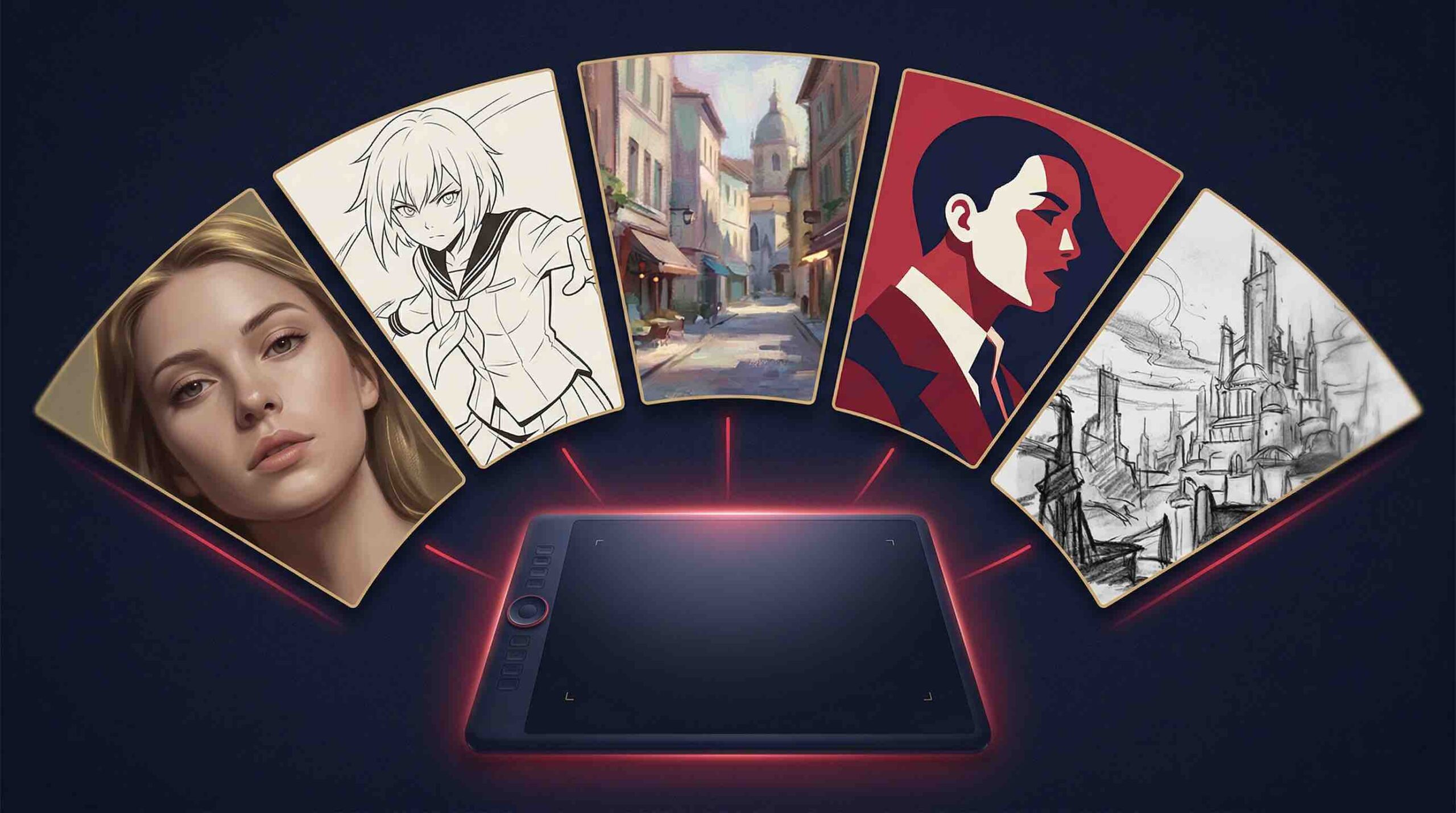
You might love manga proportions (Artist A), hyperrealism in lighting (Artist B), expressive brushwork (Artist C), and geometric color palettes (Artist D). If you're studying these artists seriously and pulling elements from each, your work will naturally blend these influences in a way that's distinctly you. Someone else has different favorite artists. They're remixing a different set of ingredients.
Think of music producers. They sample elements from different artists — a drum loop here, a horn section there, a vocal sample from another track — and remix them into something entirely new. The best producers don't hide their samples; they transform them through their own creative decisions. That's exactly how artistic style develops.
The problem most beginners face: they're remixing too few sources. They've found one artist they love and they're trying to become that person. Instead, you need to be actively studying 5, 10, 15 different artists. Pull different elements from each. Make different choices about how you combine them. Let your unique taste drive the remix.
Your personal journey is your competitive advantage.
This is where many artists miss the real magic. They think style is purely technical — it's about line quality, color choice, rendering skill. These matter. But authentic style is born from what you've lived.
Your perspective is shaped by:
Two artists can study the exact same masters, learn the same techniques, and still produce completely different work because they're filtering everything through their own lived experience. A painter who grew up in rural India will see color and light differently than someone raised in New York. An artist who spent years in corporate jobs will have a different perspective on composition and narrative than someone who grew up in traditional art schools. This is why exploring different digital art styles is crucial — not to copy them, but to understand how perspective and experience shape artistic expression. Whether you're exploring art at 25 or 50, your unique perspective is your greatest asset.
Your life isn't a distraction from developing your style. Your life IS your style. The more you understand yourself — your beliefs, your experiences, your values — the more distinctive and powerful your work becomes.

Your unique blend of influences + life experience = your unrepeatable artistic voice.
This changes everything.
Most beginners ask: "When will I have my style?" As if there's a finish line. You reach it, and then you're done. You've "found" it.
That's backwards. Your style never stops evolving. It grows as you grow. It changes as you learn. It deepens as you gain more life experience. The artists you love most — the ones whose work feels undeniably theirs — haven't found a static style. They've built a foundation and continue to evolve from it.
Look at artists across their careers:

Style evolves. It doesn't lock. Every year, you grow, and your work reflects that growth.
This is the freedom you need to understand: You don't need to lock in your style right now. You're supposed to be evolving. Every piece you create teaches you something. Every artist you study influences your thinking. Every life experience shifts your perspective. Your style at year 3 will be different from year 1 — and that's exactly what should happen.
This is the real work.
If style isn't something you find, and it's not a destination, then what is it? It's the accumulation of aesthetic choices you make consistently over time.
Your artistic identity emerges from:
Technical choices: Do you prefer soft edges or sharp ones? Rich colors or muted? Realistic proportions or stylized? These technical choices, made repeatedly, start to define you.
Subject matter choices: What themes keep showing up in your work? What subjects excite you? What stories do you want to tell?
Emotional choices: What feeling do you want your work to evoke? Warmth or mystery? Energy or calm? Joy or contemplation?
The artists with the strongest identities aren't copying anyone. They're making deliberate choices across all three dimensions — and those choices are consistent enough that you recognize their work instantly, but flexible enough that they continue to grow.

Every choice you make builds your voice. Deliberate decisions create authentic identity.
This is how you develop independent artistic identity:

Your style emerges from deliberate practice, authentic choice-making, and the courage to express your unique perspective.
Understanding style development is one thing. Seeing it demonstrated live — tools, fundamentals, workflow and where AI fits in — is another.
Join the Free Artma Workshop →Your art style won't reveal itself. It will emerge from the thousands of small choices you make, the artists you study, the life you live, and the values you develop. This is why the best time to start was yesterday. The second-best time is today. Every piece you create is building your voice — whether you realize it or not.
Our free beginners workshop covers tools and software for digital painting, the fundamentals of creativity, a live workflow demonstration, and how AI is changing what's possible for artists today.
Join the Free Workshop