


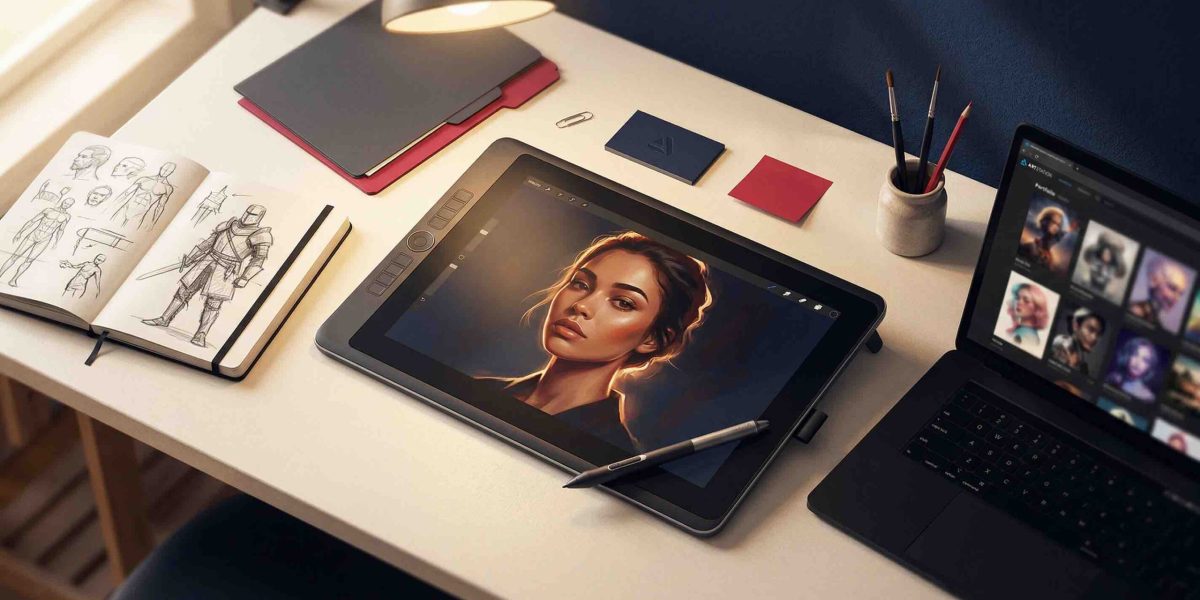
A strategic guide to curating, presenting, and growing a portfolio that actually converts — whether you want commissions, clients, or a studio job.
Your portfolio is your most powerful marketing tool as a digital artist. It is the first thing potential clients, commissioners, and employers look at — and the last thing standing between you and your next paid opportunity. We've seen hundreds of artists at Artma make the same avoidable mistakes. A strong digital art portfolio is not just a collection of your best work; it is a strategically curated argument that you are the right artist for the job. This guide walks you through building one that actually works.
The answer is deceptively simple: as few as it takes to show your best work. Quality beats quantity every time. Eight to twelve outstanding pieces will outperform forty mediocre ones. Every weak piece you include drags the perceived standard of your entire portfolio down to match it.
A portfolio of three excellent pieces and a clear artistic direction is more compelling than a gallery of twenty inconsistent experiments. Never wait until you have "enough" — start building immediately.
Beyond the artwork itself, a professional digital art portfolio needs specific supporting elements. We've reviewed portfolios from hundreds of students and clients — the ones that convert all share these four components.
Where you host your portfolio matters almost as much as what's in it. The right platform puts your work in front of the right people. Here is our honest breakdown of the four options every digital artist should know.
Platform 01
ArtStation is the gold standard for game art, concept art, and professional illustration. Art directors, recruiters, and studio heads use it daily to find talent. If you are targeting professional employment or high-level freelance work, ArtStation is non-negotiable.
Platform 02
Behance is Adobe's portfolio platform, dominant in graphic design, advertising, and brand illustration. Its deep integration with the Adobe Creative Suite makes it natural for Photoshop and Illustrator-heavy workflows. It is also indexed aggressively by Google — valuable for organic discovery.
Platform 03
A personal portfolio website gives you complete control over presentation, SEO, and branding. It looks more professional to high-value clients than a platform profile. The trade-off is the time investment of building and maintaining it.
Platform 04
Instagram and TikTok are not portfolio platforms — they are discovery engines. Their algorithm-driven reach can drive significant traffic to your portfolio from people who would never search for you directly. Follow @artma on Instagram to see how we approach platform content for a digital art brand.
Free Workshop
Join Artma's free workshop covering the fundamentals of digital painting — canvas setup, brushes, layers, and colour basics. It's a live, listen-and-follow session, perfect if you're picking up a stylus for the first time.
Reserve Your Free Spot →Curation is the art of deciding what to include, exclude, and how to order your work. It is as important as the quality of the individual pieces — and most beginner artists underestimate it entirely. In our experience, a well-curated portfolio of average work consistently outperforms a poorly curated portfolio of strong work.
The first piece a viewer sees sets their expectations for everything that follows. Make it your undeniable strongest.
Variety of subjects (portrait, environment, character) within a coherent aesthetic shows versatility without sacrificing identity.
A portfolio that builds progressively — from strong to stronger — keeps viewers engaged and leaves them on a high note.
If you pause before including a piece, exclude it. That hesitation is your instinct telling you it isn't ready.
The best curation decision you can make is ruthless exclusion. A portfolio is judged by its weakest piece, not its strongest.
We see these mistakes repeatedly at Artma — from beginners and experienced artists alike. Each one is avoidable once you know what to look for.
More is not better. Every weak piece lowers the perceived standard of your entire portfolio. Curate ruthlessly — eight strong pieces outperform forty mediocre ones.
Make it impossible to miss. If someone wants to hire you and cannot find your email in ten seconds, they will move on to the next artist.
A portfolio with work that is clearly older than a year signals stagnation. Add new work consistently and remove your oldest, weakest pieces as you improve.
Viewers want to know who you are. A brief bio humanises your portfolio and creates connection. Without it, you're just a collection of images — not a person to hire.
If you paint anime portraits and technical vector graphics, consider separate portfolio pages for each audience. Mixed styles confuse clients about what you actually do.
Every principle above is easier to apply once you've seen it in practice. Here are five artists from the Artma community — read a bit about each, then see their full portfolio via the button below.
A visual storyteller who blends bold colour and clean design into memorable brand identities. Aaditya is pursuing a design degree at Sir J.J. Institute of Applied Art, Mumbai, and has worked as a children's book illustrator for UOLO and a mural designer for Asian Paints.
View Portfolio →
A character-focused concept artist with a strong interest in cinematic superhero design. Anuj holds a degree in Animation & VFX and creates stylised characters inspired by Marvel and DC — from original creatures to reimagined icons like Nightwing.
View Portfolio →
Currently pursuing fashion design at NIFT, Krishna brings that eye for detail into cartoon-style portraits, hyper-realistic paintings, and brand illustration — working across commissions, book illustration, and digital galleries.
View Portfolio →
A psychology student and multimedia digital artist blending emotional insight with creative expression. Sneha works across landscapes, portraits, mandala art, and isometric illustration — experimenting with traditional and digital mediums to create work that feels thoughtful, expressive, and emotionally relatable.
View Portfolio →
An AI artist with three years of experience working at the intersection of visual storytelling and AI-assisted creativity. Surya is drawn to divine figures and mythological stories, reimagining them through modern AI tools — fine-tuning prompts, composition, and detail until each image feels powerful, calm, and alive.
View Portfolio →
✦ Visual Guide
Follow the workflow to build it right from the start. Run through the checklist before you share your portfolio with the world.
Create 3–5 fully rendered, polished artworks you're genuinely proud of. No rough sketches — only work you'd confidently show a client counts here.
Artma tip: Join our free workshop on the basics of digital painting to help produce your first portfolio-quality piece.Pick one primary platform — ArtStation for professional work, Behance for design. Complete your profile fully before uploading a single piece.
Don't skip: A half-empty profile hurts more than no profile at all.Draft a 3–4 sentence professional bio. State who you are, your style, and what work you're available for. Add a visible email address — make it impossible to miss.
Rule: If someone has to search for your contact info, you've already lost the job.Include at least one time-lapse, sketch, or in-progress screenshot per major piece. This proves the work is yours, demonstrates your method, and builds immediate trust.
Bonus: Process content performs extremely well on Instagram and TikTok for discovery.Remove anything you'd hesitate to show a client. Order your remaining pieces so your strongest work appears first and last. The middle can carry your range.
Curation rule: Every weak piece you include drags the entire portfolio down to match it.Share your portfolio link on every social platform. Then set a monthly reminder to review: replace your weakest piece whenever you create something better. A living portfolio grows your career continuously.
Mindset: Your portfolio is never finished — it is always a current draft.✦ Pre-Launch Checklist
Before you share your portfolio link with anyone — run through every item below. Each unchecked box is a reason a potential client might move on.
✦ Read Next
Keep building your skills
Every skill on this page starts with the fundamentals. Join Artma's free workshop and get a clear, beginner-friendly walkthrough of digital painting basics — no experience, no equipment stress, just show up and learn.