


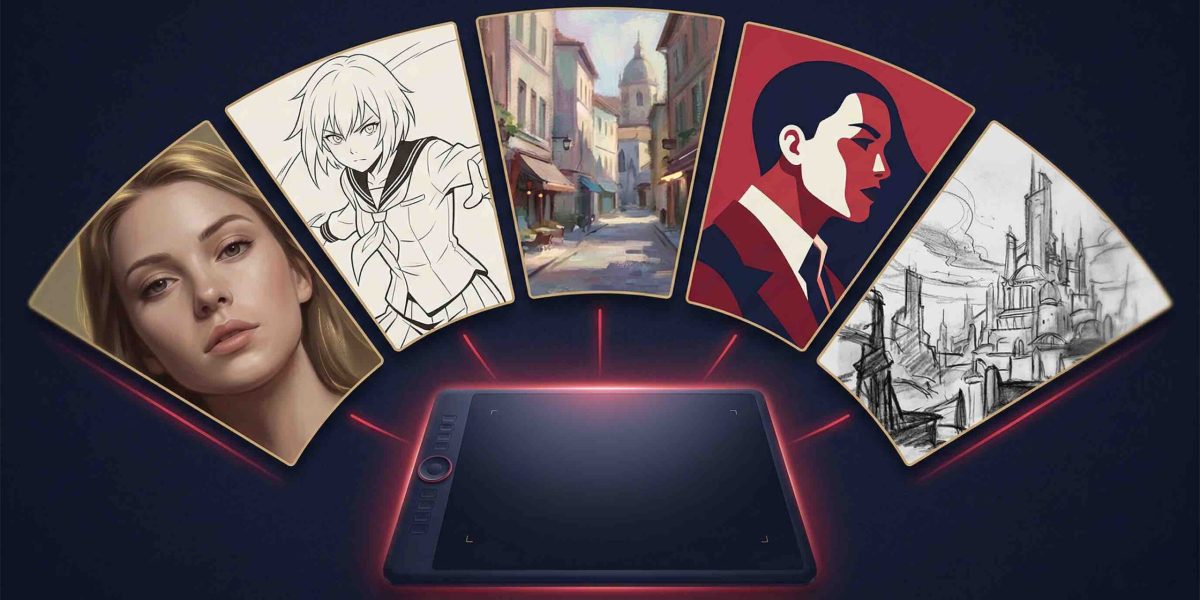
The most popular styles, what each one demands, and which makes the smartest starting point for your goals.
One of the first decisions every new digital artist faces — and often agonises over — is which style to pursue. The choice matters more than most beginners realise. We've worked with hundreds of students at Artma and seen firsthand how picking the wrong style early leads to months of frustration. Different digital art styles require different tools, develop different skills, and lead to very different career and income paths. In this guide, we break down the most popular styles, what each one demands, and which makes the most sense as your starting point.
Realistic digital painting aims to reproduce subjects — portraits, environments, objects — with photographic accuracy. Every highlight, shadow, texture, and reflected light is observed and rendered precisely. Hyperrealism pushes this further, producing work that is difficult to distinguish from photography at first glance.
Realism is technically demanding but produces work with universal appeal and strong commercial value — particularly for portrait commissions and print sales.
Semi-realism occupies the sweet spot between photorealism and stylisation. It uses realistic lighting and anatomy as a foundation but simplifies details, enhances features, and introduces a degree of artistic interpretation. This is one of the most popular styles on platforms like Instagram and ArtStation, and one of the most commercially versatile.
Anime and manga art styles are characterised by large expressive eyes, clean line work, flat cel shading or soft gradients, and stylised proportions. These styles have an enormous and highly engaged online following — making them excellent for building an audience and taking commissions. The rules of the style are well-defined and extensively documented, which is helpful for self-learners.
Anime/manga has a massive commission market and one of the strongest beginner communities online — excellent if you love the aesthetic.
✦ Free Workshop
Get personalised guidance at the Artma free weekly workshop — we help every attendee find the style that matches their goals and natural tendencies.
Reserve Your Free Spot →Concept art is the visual design language of the entertainment industry — games, film, animation, and virtual reality. Concept artists design characters, environments, vehicles, creatures, and props before they are built in 3D or animated. It is fast-paced, iterative, and communication-focused: a concept artist's job is to clearly communicate ideas to a production team, not to produce finished paintings.
Painterly digital art embraces visible brushstrokes, textured surfaces, and expressive colour choices — it looks like it was made with physical paint, not a computer. This style prizes emotional impact and atmosphere over precision. It is the closest digital equivalent to oil or watercolour painting.
Flat and graphic illustration uses clean shapes, limited colour palettes, and minimal shading to create bold, immediately readable imagery. This style dominates product design, tech branding, social media graphics, and children's publishing — making it one of the highest-demand commercial illustration styles in 2026.
| Style | Difficulty | Best For | Income Path |
|---|---|---|---|
| Realism / Hyperrealism | High | Strong fundamentals, long-term mastery | Portrait commissions, print sales |
| Semi-Realism | Medium | Most beginners — versatile & in demand | Character commissions, illustration |
| Anime / Manga | Low–Med | Anime fans, community-builders | Commissions, webtoons, fan art |
| Concept Art | High | Games/film career ambitions | Studio employment ($60k–$130k+) |
| Painterly | Medium | Traditional painters going digital | Print sales, book illustration |
| Graphic / Flat | Low–Med | Fast commercial income | Highest commercial demand |
Match your goals and personality to the right starting point:
Love expressive, paint-like art and have patience for slow, careful work
Semi-RealismLove anime, manga, and Japanese media — and want a strong commission market fast
Anime / MangaWant to work in games, film, or animation as a career
Concept Art FoundationsWant commercial income as quickly as possible
Flat / Graphic IllustrationWant the strongest possible foundational skills that transfer to any other style
Semi-Realism Fundamentals transfer universallyWhatever style you choose, the underlying fundamentals — value, colour, composition, and form — are universal. Developing them is what makes you adaptable. Start with the Artma free weekly workshop to build those foundations in a style-agnostic way, then specialise with confidence.
The main types include realism, semi-realism, anime/manga, concept art, painterly/impressionistic, graphic/flat illustration, and pixel art. Each has distinct techniques, software preferences, and career applications.
Anime/manga art and semi-realism are the most forgiving starting points for most beginners. Both have clear visual rules, strong community resources, and active commission markets for developing artists.
For the first year or two, yes. Focusing on one style accelerates improvement and builds a coherent portfolio. Once your fundamentals are solid, exploring other styles becomes much faster because the core skills transfer universally.
✦ Read Next
Keep building your skills
Join the Artma free weekly workshop and get personalised advice on which style matches your goals — plus live painting demonstrations across multiple styles.

© 2026 By Artma.io. All rights reserved.